How to Redact an ID Card Safely
A conservative checklist for hiding identity numbers, addresses, signatures, and machine-readable regions.
Prepare an ID image locallyDirect answer
Cover every field the recipient does not explicitly need, including repeated numbers, barcodes, QR codes, signatures, and background documents. Export a new flattened image and remove metadata from that copy.
This guide's before-and-after files
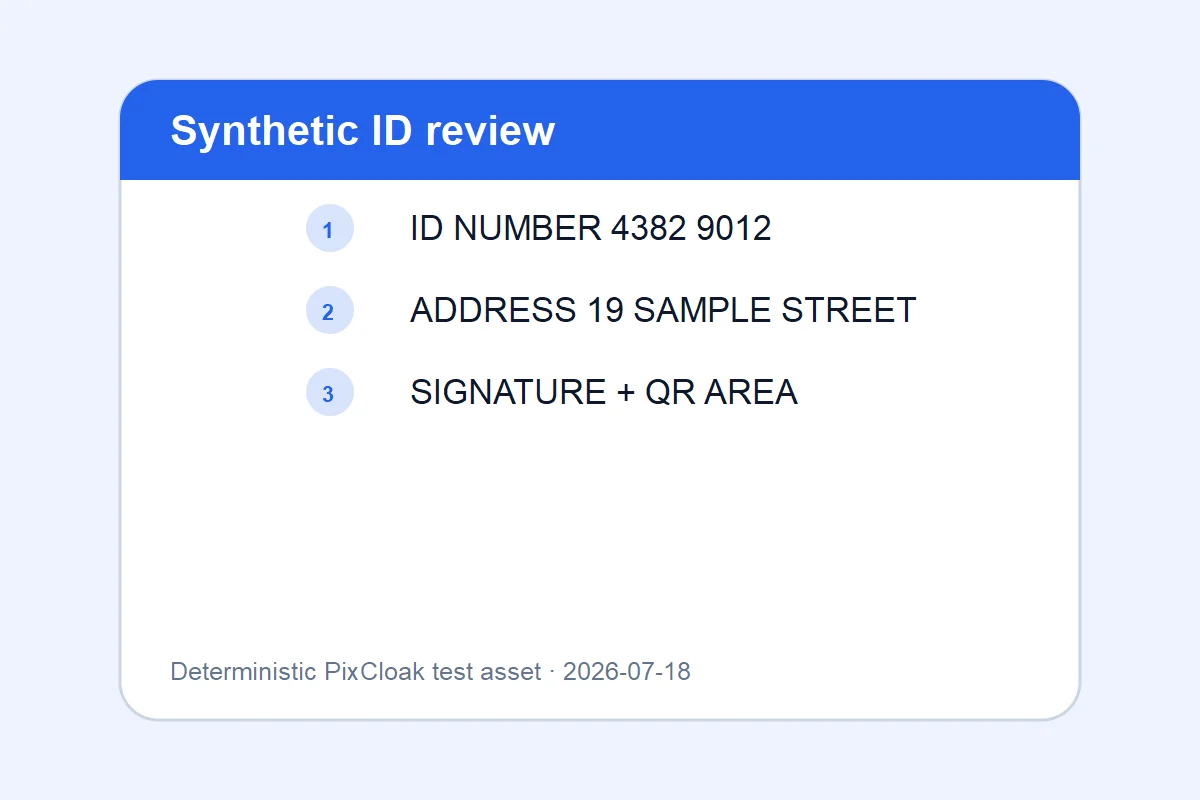
1200×800 · 26.36KB · download file
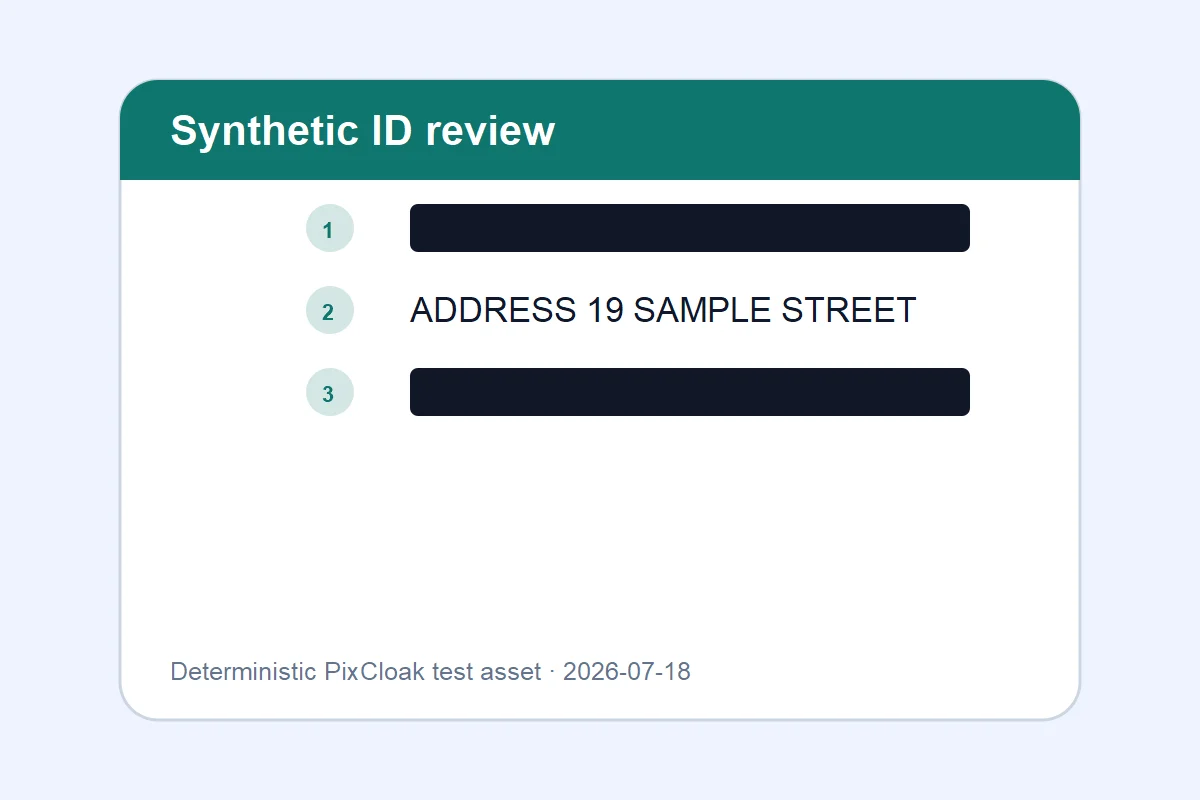
1200×800 · 18.72KB · download file
Every non-required synthetic field is covered in the exported image.
Both downloadable WebP files are generated from deterministic SVG test inputs; their hashes and dimensions are verified.Validation date: 2026-07-18. Both files are downloadable; dimensions, byte counts, decodability, and distinct SHA-256 hashes are checked by the repository test suite.
Use the verified workflow
- List the fields the recipient actually needs.
- Cover all other text, codes, faces, signatures, and document numbers.
- Review the export separately from the original before sharing.
Limits and failure cases
- Requirements vary by recipient and jurisdiction.
- PixCloak does not decide which identity fields a verifier legally needs.
Official sources and verification
Tool behavior and samples were checked on 2026-07-18. External references:
Common question
Does PixCloak upload the source image?
No. The editing pipeline uses browser File, Canvas, and Blob APIs on this device. Optional analytics and advertising are separate and load only after the applicable consent choice; product events never include image bytes or filenames.